FWO FKM funding awarded to Prof. dr. Marije Meeuwissen
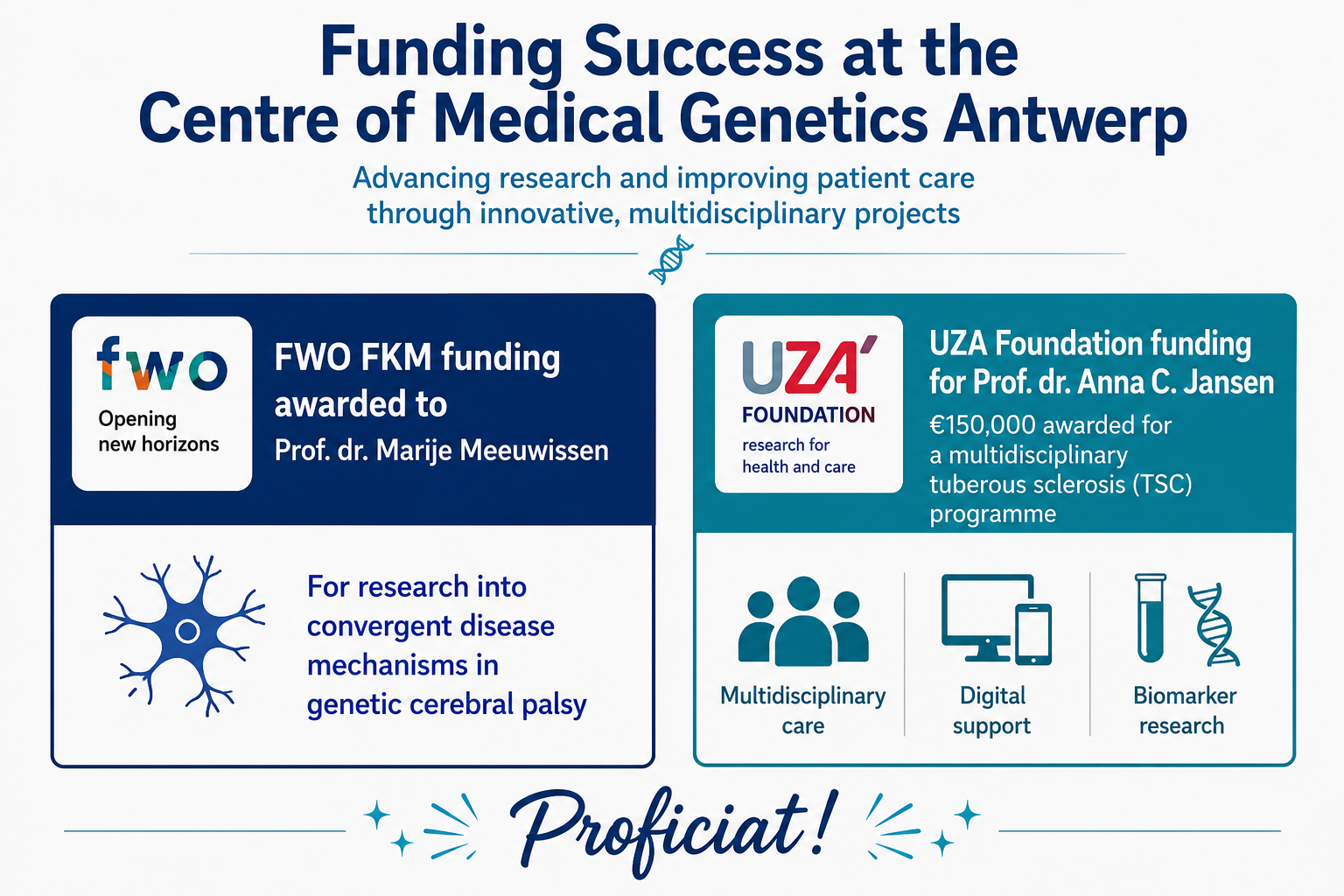
FWO FKM funding awarded to Prof. dr. Marije Meeuwissen for research into convergent disease mechanisms in genetic cerebral palsy
We are delighted to share that Prof. dr. Marije Meeuwissen has been awarded FWO FKM funding for an ambitious research project investigating shared pathogenic mechanisms in genetic forms of cerebral palsy (CP). Although cerebral palsy has long been viewed primarily as a consequence of perinatal injury, recent genetic studies have shown that a substantial proportion of patients carry pathogenic variants in genes involved in neurodevelopment, intracellular trafficking and axonal transport. However, despite this growing recognition of the genetic contribution to CP, the biological mechanisms shared across genetically distinct forms of the disorder remain poorly understood.
Prof. Meeuwissen’s project addresses this challenge by focusing on ATG9A mislocalisation and defective axonal transport/autophagy as a possible convergent disease mechanism across multiple CP-related disorders, including AP-4 deficiency syndrome, KIF1A-associated neurological disorder, KIF5C-related disease and a newly identified KLC4 deficiency. Preliminary work from the group has already shown that patient-derived fibroblasts from several of these disorders display abnormal accumulation of ATG9A at the trans-Golgi network, pointing to disturbed intracellular trafficking as a common cellular read-out. The project now aims to test the hypothesis that impaired ATG9A transport represents a unifying pathogenic pathway in genetic CP, and that disrupted autophagy may increase neuronal vulnerability to environmental stressors such as hypoxia.
To tackle this, the project combines human iPSC-derived neuronal models and in vivo mouse modelling to compare different CP-associated transport disorders within a single experimental framework. The work will examine ATG9A trafficking, autophagy regulation, neuronal morphology, synaptic transmission and network activity, and will also explore how these cellular defects are modified by environmental stressors relevant to CP. In addition, the project includes a translational therapeutic arm that will test whether pharmacological stimulation of autophagy or enhancement of axonal transport can rescue disease phenotypes across multiple models. Finally, the project will characterise a novel KLC4 knockout mouse model, providing the first mammalian in vivo system to study this emerging neurodevelopmental disorder.
By moving beyond a single-gene approach and directly comparing several rare genetic forms of CP, this project has the potential to uncover shared molecular pathways and common therapeutic entry points. The award is therefore an important recognition of innovative, mechanism-driven translational research at the Centre of Medical Genetics Antwerp. We warmly congratulate Prof. Meeuwissen on this achievement.
UZA Foundation funding for Prof. dr. Anna C. Jansen
UZA Foundation awards €150,000 to multidisciplinary tuberous sclerosis project led by Prof. dr. Anna C. Jansen
We are proud to announce that the Scientific Council of the UZA Foundation has awarded €150,000 in funding to a multidisciplinary project led by Prof. dr. Anna C. Jansen, entitled “Tuberous Sclerosis Complex: A Multidisciplinary UZA Programme to Improve Patient Care through Cohort Characterisation, Digital Support and Biomarker Research.”
Tuberous sclerosis complex (TSC) is a rare multisystem genetic disorder caused by pathogenic variants in TSC1 or TSC2 and characterised by the development of benign tumours in multiple organs, including the brain, kidneys, skin and heart. In many patients, TSC is also associated with epilepsy, autism spectrum features, intellectual disability and other neurodevelopmental challenges, making clinical care highly complex and requiring close collaboration between multiple medical specialties.
The newly funded programme aims to improve care for individuals with TSC through an integrated and multidisciplinary approach. The project combines cohort characterisation, digital patient support and biomarker research in order to better understand disease variability, improve clinical follow-up and create a stronger evidence base for personalised care. By systematically characterising the UZA TSC patient population, the team seeks to gain deeper insight into the neurological and systemic manifestations of the disorder, disease trajectories and unmet care needs. At the same time, the project will explore how digital tools can support patients and families in the management of this lifelong condition, while biomarker studies will help identify measurable indicators linked to disease burden, prognosis and treatment monitoring.
This funding will allow the team to build a more integrated TSC care and research programme at UZA, with the ultimate goal of translating research findings into better diagnostics, more tailored follow-up and improved quality of life for patients and families. The award is a strong recognition of the importance of multidisciplinary translational research in rare neurological disease, and we warmly congratulate Prof. Jansen and the entire team on this achievement.